

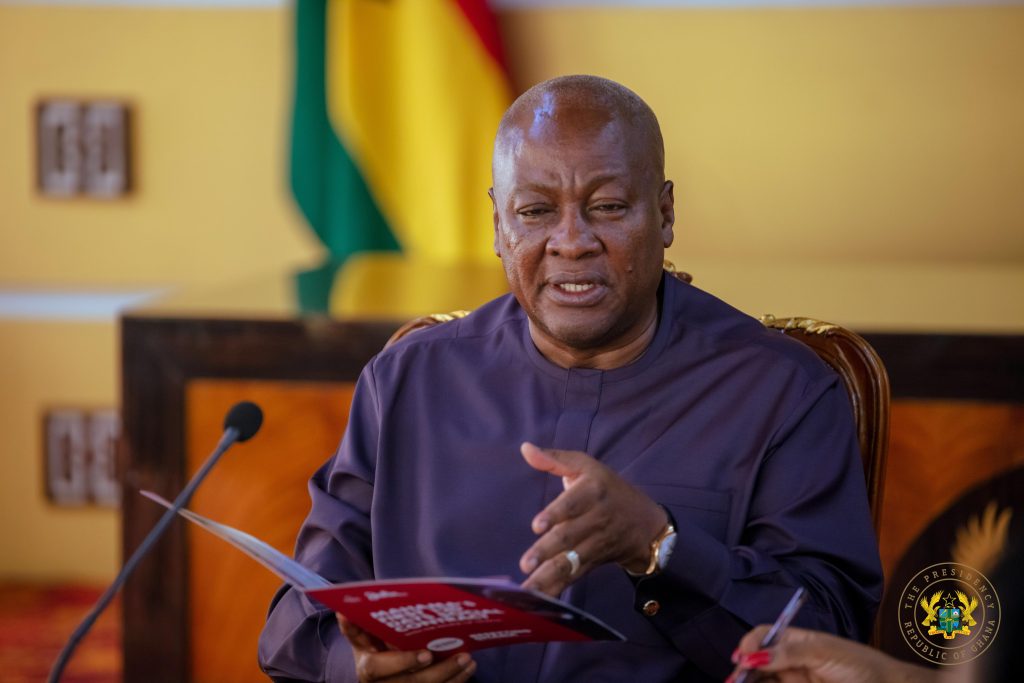
Speaking during his Resetting Ghana Tour of the Upper East Region, the President revealed that the government has adopted a robust new approach to prevent illegal miners from returning to forest reserves after they have been cleared of activities.
Under this newly adopted enforcement strategy, the government is deploying permanent military detachments to remain inside reclaimed forest reserves long after illegal miners have been initially driven out.
President Mahama explained that this aggressive measure became necessary following the failure of the previous approach, which relied on handing cleared lands back to the Forestry Services Commission. Highlighting the limitations of civilian enforcement, the President stated,
“Before, what we did was when we cleared, we handed over to the Forestry Services Commission. But they don't fear the Forest Service; they go and drive the forest guards out, and they go back into the mine. And so now we put a military detachment.”
Maintaining active military units in remote forests places a significant financial burden on the state, as the government must provide continuous funding to feed the soldiers and supply them with the logistics to stay in the forest.
Despite the additional cost, the President reaffirmed his government's unwavering commitment to the environmental struggle, declaring,
“But we will not give up; we will continue the fight against illegal mining.”
The National Anti-Illegal Mining Operations Secretariat (NAIMOS) has played a central role in these ongoing enforcement operations, leading the charge in reclaiming forests that have suffered extensive encroachment.
According to the President, NAIMOS has worked incredibly hard to clear as many as possible of the nearly forty-nine forest reserves that had been invaded by illegal miners across the country. Describing the cat-and-mouse nature of the enforcement, Mahama shared,
“We are working; NAIMOS is working very hard. We've seized excavators, we've seized Changfan machines, and you drive them out of this area, they run to this other area. But we are making progress.”
While focusing heavily on curbing unregulated activities, the government also recognizes the potential of the mining sector to create sustainable employment opportunities for young people.
The target is to formalize and establish greater control over mining activities, replacing scattered illegal operations with regulated mines that can employ local youth. The President cited the opening of the Cardinal Mine in the Upper East Region and the upcoming Black Volta mine development in the Upper West Region as prime examples of how proper, regulated mining can contribute to job creation.
Furthermore, President Mahama drew an important distinction between mining activities in the Upper East Region and the devastating environmental damage associated with illegal mining in southern Ghana's forests. He pointed out that much of the gold in the Upper East Region is embedded in rock formations, meaning that mining there involves blasting and processing the rock rather than destroying delicate forest canopies and riverbeds.
Explaining this geographical advantage, the President noted,
“The advantage with the Upper East Region is that most of the places where the gold is found are found in rock. And so it does not create the kind of environmental destruction that we see in the south.”
He added that because they must blast and process the rock to extract the gold, it is a fortunate circumstance that the region does not experience the same extent of forest devastation seen in southern Ghana.
This new policy framework therefore represents a dual approach of combining strict security presence in reclaimed zones with a concerted push to formalize and regulate mining operations outside protected areas.

Comments (0)
No comments yet. Be the first to share your thoughts.