

In an increasingly digital business landscape, regulatory compliance in cybersecurity is no longer just a checkbox exercise—it has become a critical legal and operational boundary in Ghana. A powerful reminder of this reality came on August 12, 2026, when the Cyber Security Authority (CSA) of Ghana announced a combined fine of GH¢360,000 against the Office of the Registrar of Companies (ORC) and a private IT firm, Purpleline Solutions Limited Company.
This landmark enforcement action highlights the CSA’s growing intolerance for licensing breaches and underscores the strict obligations placed on entities managing critical systems.
For businesses, state enterprises, and public sector organizations across Ghana, this case serves as an urgent warning: ignoring cybersecurity directives or bypassing official channels carries severe financial and reputational consequences.
To understand the gravity of the situation, it is necessary to examine how these violations unfolded under the provisions of the Cybersecurity Act, 2020 (Act 1038).
The Office of the Registrar of Companies (ORC), which is the government agency responsible for business registrations and corporate filings, is legally classified as a designated Critical Information Infrastructure (CII) institution.
Because CII institutions handle highly sensitive national registries and corporate databases, they are legally mandated to engage only appropriately licensed Cybersecurity Service Providers (CSPs) to protect their digital systems.
Recognizing the need to secure these systems, the CSA issued official directives to the ORC on June 15, 2026, ordering it to contract a Tier 1 licensed CSP to strengthen and fortify its digital security.
In addition to this specific directive, the ORC was required to provide the CSA with details on its current cybersecurity service providers, the Terms of Reference (ToR) for its proposed Security Operations Centre (SOC), and the relevant approvals from the Public Procurement Authority (PPA).
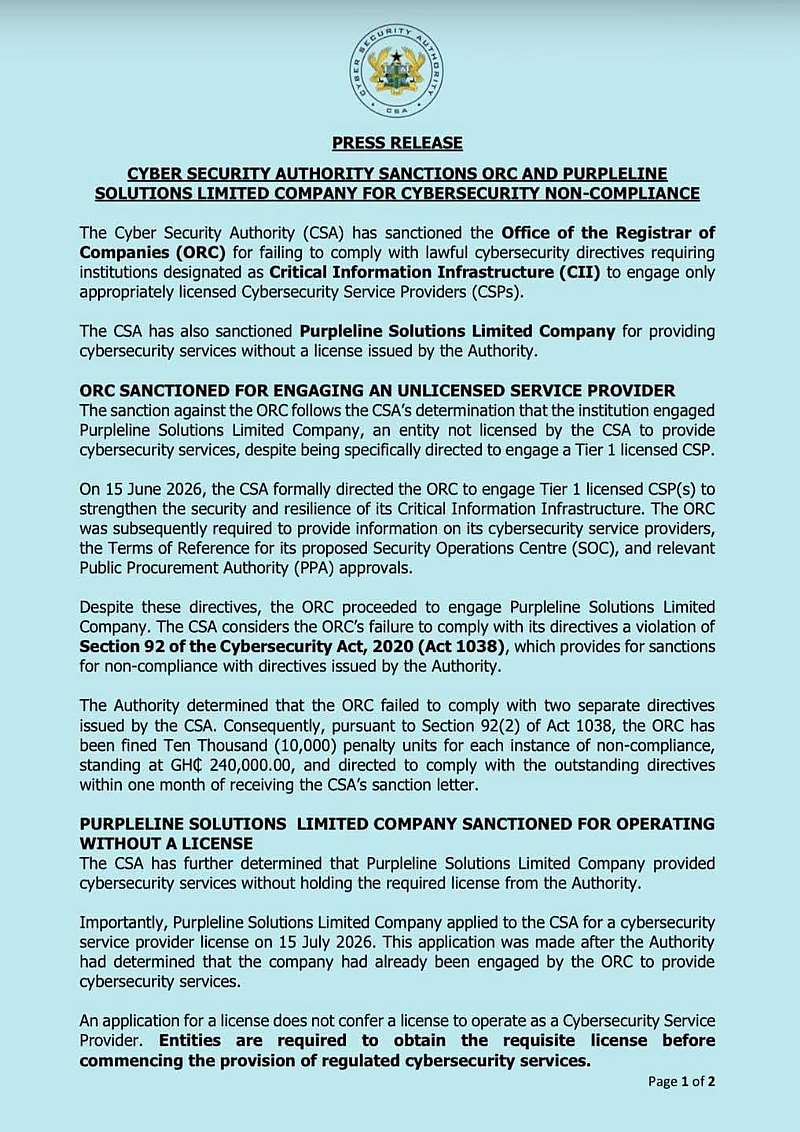
Despite these clear, lawful instructions, the ORC proceeded to contract Purpleline Solutions Limited Company, an IT firm that did not hold the required CSA license to offer regulated cybersecurity services.
The CSA determined that the ORC’s failure to comply with these two separate administrative directives constituted a direct violation of Section 92 of the Cybersecurity Act, 2020 (Act 1038).
Under Section 92(2) of the Act, the ORC was fined 10,000 penalty units for each instance of non-compliance, resulting in a total penalty of GH¢240,000.
The regulatory body has also given the ORC a strict one-month deadline from the receipt of the sanction letter to resolve the outstanding directives and bring its operations into full legal compliance.
At the same time, the private contractor, Purpleline Solutions Limited Company, faced direct regulatory action for its role in the breach.
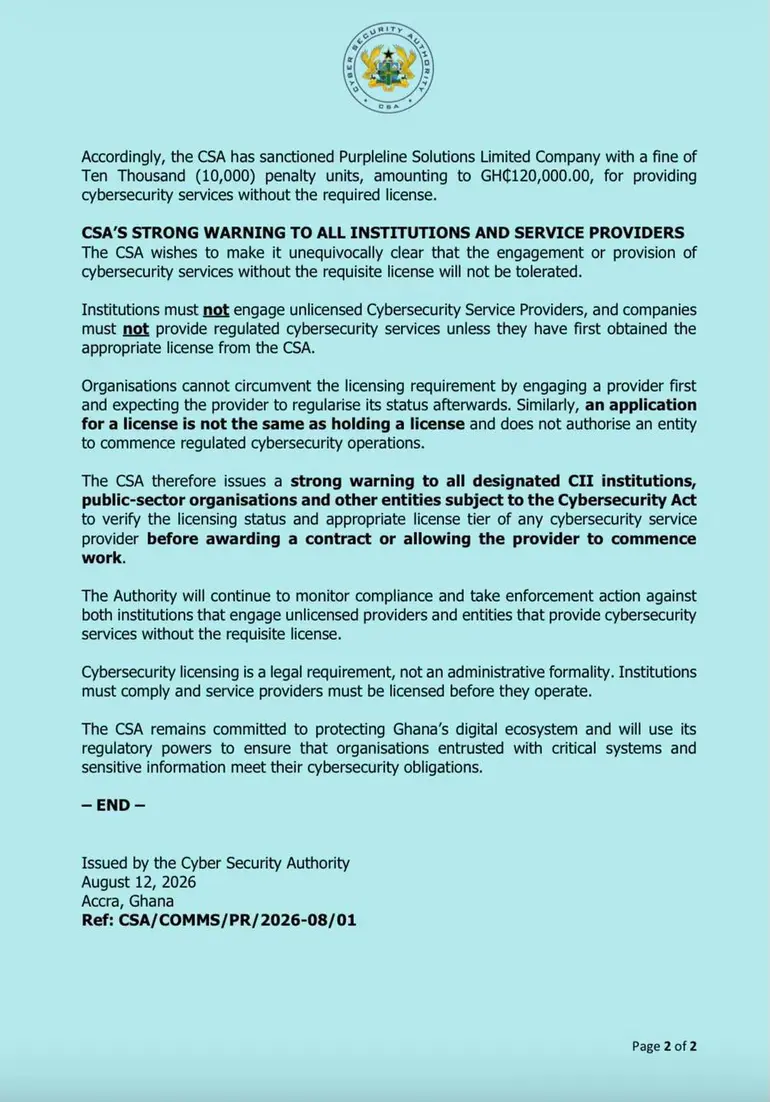
The company was fined 10,000 penalty units, equivalent to GH¢120,000, for providing regulated cybersecurity services without holding the proper license from the CSA. Although Purpleline did submit an application for a cybersecurity service provider license on July 15, 2026, the CSA pointed out that this application was filed after the company had already been contracted and had commenced work for the ORC.
The regulatory authority has made it clear that merely applying for a license does not grant authorization to operate [8, 38]. In the eyes of the regulator, a pending application is not a substitute for an active, approved license, and entities must wait for full official approval before offering any cybersecurity services to the public or private sector.
This double-sided enforcement reveals a major shift in how cybersecurity is regulated in Ghana, showing that the CSA is actively emphasizing that cybersecurity licensing is a strict legal requirement, not an administrative formality.
Moving forward, the CSA has directed all public-sector organizations, CII institutions, and other entities covered by the Cybersecurity Act to verify both the licensing status and the specific licensing tier of any cybersecurity firm before signing contracts or allowing any technical work to begin.
For Ghanaian business owners, directors, and IT leaders, this enforcement highlights several vital lessons:
Verify before you hire: Never assume an IT partner is legally cleared to handle your security. Always request proof of their active CSA license and check their approved tier.
A pending application is not a license: If a service provider tells you their licensing is "in progress" or "pending," they cannot legally begin operations or sign contracts for regulated services.
Critical infrastructure has higher standards: Organizations that manage public records, financial transactions, or sensitive corporate databases have a much higher legal burden of care and must comply swiftly with CSA security directives.
The regulator is watching: The CSA has warned that it will continue to actively monitor compliance across the country and will not hesitate to take swift enforcement action against both the clients who hire unlicensed firms and the firms that illegally provide these services.
Ultimately, the GH¢360,000 penalty imposed on the ORC and Purpleline Solutions is a turning point for Ghana's digital ecosystem, demonstrating that the Cyber Security Authority is fully prepared to use its legal powers to protect national infrastructure.
As Ghana continues its digital transformation journey, businesses and state institutions must treat cybersecurity compliance as a core pillar of corporate governance rather than an afterthought.
To protect your organization from severe financial penalties and reputational damage, now is the time to audit your IT partnerships. Visit the official Cyber Security Authority Ghana portal today to verify the status of your security vendors and ensure your business remains on the right side of Act 1038.





Comments (0)
No comments yet. Be the first to share your thoughts.