

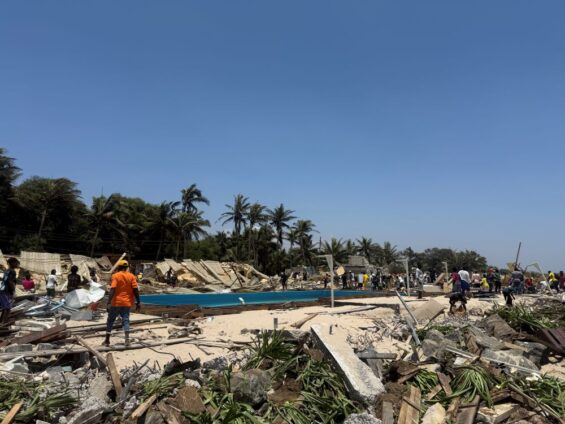
The exercise commenced around 4:00 a.m. on Friday when security personnel arrived at the beachfront and instructed residents, workers, and business operators to immediately vacate the premises.
A joint force comprising personnel from the Ghana Armed Forces’ 48 Engineer Regiment and the Ghana Police Service supervised the operation, ensuring that heavy machinery could systematically level the targeted permanent and semi-permanent structures without operational disruption. This joint deployment followed earlier clearance activities in the La Pleasure Beach area, which had previously faced resistance from local vendors and structure owners.
As images and videos of the rubble began circulating, rumors quickly spread that the demolition was a state-led environmental intervention or flood prevention measure. However, official clarification soon followed to set the record straight.
Deputy Chief of Staff in Charge of Operations, Stan Dogbe, released a public statement clarifying that the exercise was not part of the government’s ongoing flood mitigation task force. He pointed out that government operations along areas such as the Kpeshie Lagoon, East Legon Boundary Road, and Oyarifa were dedicated efforts supporting the Ministry of Works, Housing and Water Resources, whereas the La Beach demolition was an entirely separate matter. In his words,"
Friday’s action along a section of the beach front was not a Flood Mitigation Action by the government task force".
Instead, the Deputy Chief of Staff revealed that the demolition was initiated at the specific request of the management of Labadi Beach Hotel and executed under the supervision of National Security.
According to Dogbe, the management of the hotel had raised urgent concerns regarding unauthorized permanent structures erected directly on the beach fronting their property.
Hotel leadership reported that these unregulated establishments severely compromised safety, guest comfort, and operational standards. Quoting Dogbe directly,the structures were
adversely affecting the safety, tranquillity and reputation of the Hotel, diminishing the visitor experience and undermining the orderly management of one of Ghana's most important tourism destinations".
Beyond brand reputation and guest experience, the exercise highlighted broader regulatory and public health issues along Accra’s coast. Dogbe emphasized that unauthorized commercial operations along the shoreline generate significant environmental and security challenges that cannot be ignored.
He noted, "While the hotel will be able to explain, in more detail, the necessity for its action to reclaim its beach front, we must all be concerned about the serious sanitation issues that these unauthorised and unregulated commercial operations cause, in addition to the security risks".
Reaffirming the legitimacy of the hotel’s legal and operational rights to its beachfront property, he added,"Is the Labadi Beach Hotel not right in reclaiming its beach front? (I am not talking about the La Pleasure Beach, please)". Security personnel remain stationed along the La Beach corridor to oversee ongoing clearance and maintain order as the land is reclaimed.
The demolition of the Polo Beach Club and surrounding structures underscores the growing tension between unauthorized commercial operations and premium hospitality management along Ghana’s coast.
While the loss of a prominent leisure venue impacts local event organizers and vendors, the action by Labadi Beach Hotel reflects an effort to enforce security, sanitation, and international tourism standards.
As coastal regulation enforcement continues in Accra, businesses must prioritize proper legal licensing and location planning

Comments (0)
No comments yet. Be the first to share your thoughts.