
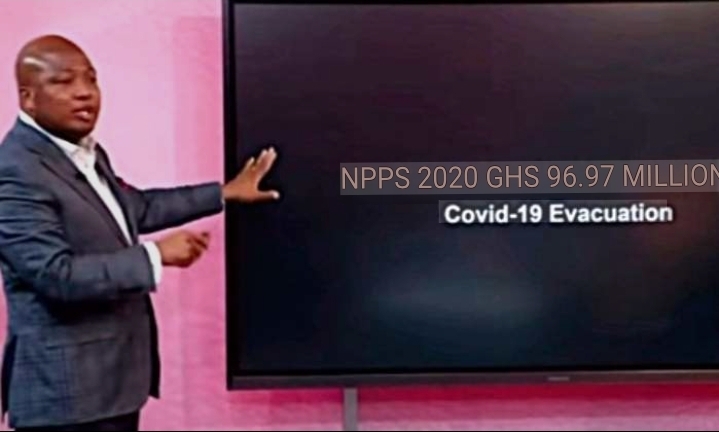
The political controversy began when the Minority in Parliament issued a press statement alleging that GH¢16.4 million spent during the evacuation exercise carried out between May 27 and September 4 was unaccounted for.
Responding to these claims of financial impropriety, Ablakwa firmly stated,
I can state unequivocally, without any scintilla of doubt, that not a cedi, not a pesewa, is missing.
To support his stance, the Minister presented a detailed breakdown of the GH¢49,721,786 total expenditure for evacuating 1,964 Ghanaians following xenophobic violence in South Africa that tragically claimed the lives of four Ghanaians.
Out of the total budget, the Government of Ghana contributed GH¢33,721,786, while Engineers and Planners, owned by businessman Ibrahim Mahama, donated GH¢16 million toward the humanitarian operation.
A central component of the Minister’s presentation focused on the direct cash disbursements made to returning citizens upon arrival.
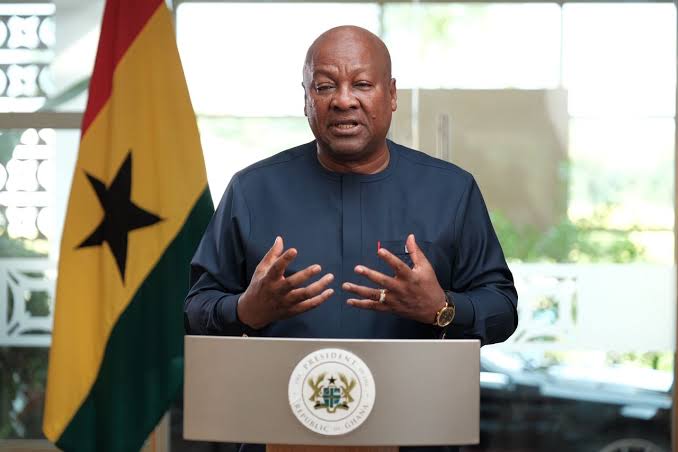
Under instructions from President John Dramani Mahama, every evacuee, including children, received a GH¢5,000 reintegration allowance alongside a GH¢500 transport stipend, bringing the total payout per person to GH¢5,500.
In total, GH¢10,802,000 was disbursed in allowances, a process conducted openly at the Accra International Airport under full media coverage, where returning evacuees verified and counted their money on site.
An additional GH¢84,274 was spent on the autopsy and repatriation of the mortal remains of two deceased Ghanaians, while the remaining balance covered hospital bills and medical treatment for sick evacuees.
To corroborate these payments, the Ministry presented a 177-page sign-off document containing the names, dates of birth, passport numbers, phone numbers, and ink signatures of all 1,964 beneficiaries.
Flight costs represented the largest portion of the operational budget, totaling GH¢38,835,512.00.
The Ministry airlifted 956 evacuees on chartered flights and 1,008 on commercial flights via Air Tanzania (598 passengers), Ethiopian Airlines (260), Asky (130), and Egypt Air (20).
Addressing critics, Ablakwa emphasized that all transactions were backed by official receipts, boarding passes, tickets, and flight manifests.
Directing a question at the Minority, he asked,
If you can't count manually, how about checking the receipt, the ticket, the boarding passes? The flight manifest has the full 1,964 names.
In dissecting the Minority’s press statement, Ablakwa highlighted several numerical contradictions, describing their document as containing blatant fabrications, embarrassing discrepancies and infantile errors.
He pointed out that paragraph 19 of the Minority's statement cited an unaccounted figure of GH¢16,423,470.00, whereas paragraph 22 put the figure at GH¢16,302,586.00—a variance exceeding GH¢120,000.
Additionally, while paragraphs 9 and 10 claimed that only 824 evacuees received allowances, paragraph 15 stated that 1,508 individuals signed for the GH¢5,000 package and 1,001 signed for the GH¢500 transport allowance.
Questioning the logic behind these conflicting numbers, the Minister asked,
How is that possible? What kind of voodoo analysis is this?.
He further noted that while the Minority claimed only 247 Ghanaians traveled on commercial flights, they counted 442 minors from commercial flights.
Mocking the mathematical error, Ablakwa added,
You claim there are only 247 on commercial flights and yet you count 442 children. More than the total number. Their argument collapses like a pack of cards.
To provide broader perspective on emergency expenditure, Ablakwa contrasted the South Africa operation with the 2020 COVID-19 evacuations, which cost taxpayers GH¢96.97 million.
By contrast, the South Africa operation fully funded air travel, medical care, and direct stipends within a lower overall cost structure.
During COVID-19, GH¢44 million was spent on mandatory quarantine alone, despite most evacuees paying for their own airfare, testing, and quarantine fees.
In response to the Minister’s presentation, Samuel Abu Jinapor, Ranking Member of the Select Committee on Foreign Affairs, clarified that the Minority Caucus was not accusing Minister Ablakwa of theft, embezzlement, or personal wrongdoing.
Jinapor explained that the Minority was carrying out its parliamentary oversight responsibility to flag apparent discrepancies and stated that a formal state audit would conclusively settle the matter.
While acknowledging that Ablakwa's presentation was helpful, Jinapor maintained that official auditing processes remain necessary to ensure full public accountability.
The national discourse regarding Ghana's South Africa evacuation expenditure highlights the critical role of parliamentary oversight and public accountability in democratic governance.
By detailing every expenditure—from airline receipts and flight manifests to signed beneficiary sheets for cash stipends—Foreign Affairs Minister Samuel Okudzeto Ablakwa provided a thorough accounting while welcoming formal auditing processes.
Comments (0)
No comments yet. Be the first to share your thoughts.