

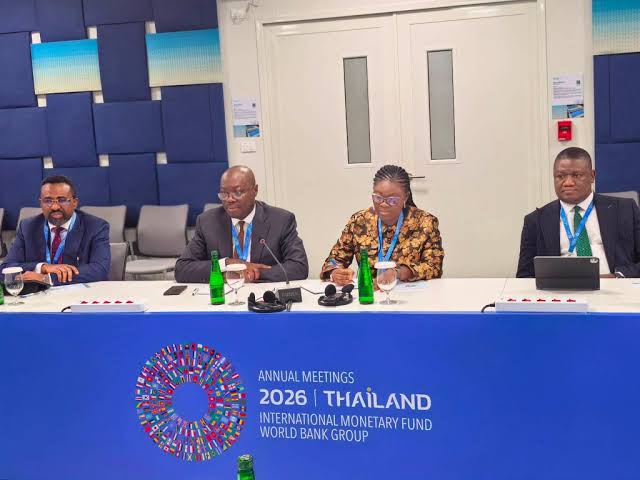
The positive evaluation of Ghana’s economic standing was delivered by Zeine Zeidane, Director of the IMF’s African Department, during the 2026 IMF and World Bank Annual Meetings in Bangkok, Thailand.
Addressing questions on the impact of global trade disruptions on African exporters, Mr. Zeidane emphasized that while falling commodity prices remain an inherent risk for primary producers, Ghana’s proactive policy adjustments have substantially altered its vulnerability profile.
Highlighting the country’s progress, Mr. Zeidane stated, 
“The performance has been strong up to now. Things are moving in Ghana in the right direction”.He further reassured stakeholders that while no economy is immune to global headwinds,“if that happens, Ghana will face them with a very strong position”.
This newfound resilience rests upon tangible macroeconomic improvements and prudent fiscal management implemented over recent months.
International credit rating agencies have responded to these developments by upgrading Ghana’s sovereign ratings, signaling renewed investor confidence in the nation's financial trajectory.
Furthermore, the IMF’s October 2026 World Economic Outlook revised Ghana’s GDP growth forecast upward to 5.7% for the year, reflecting a robust rebound driven largely by the industrial and mining sectors.
Central to this trade strength has been an unprecedented gold boom; recent Bank of Ghana data indicates that gold exports generated a record $18.2 billion in earnings during the first half of 2026, pushing total export revenues to $22.4 billion.
Crucial to sustaining this momentum is Ghana's transition in financial policy administration. Having successfully completed the final review of its Extended Credit Facility (ECF) programme in July, Ghana has officially transitioned into a 36-month Policy Coordination Instrument (PCI).
Unlike emergency financing frameworks, the non-financing PCI focuses on locking in hard-won stabilization gains, strengthening debt sustainability, enhancing governance, and maintaining structural reforms without relying on direct IMF loans.
Nevertheless, analysts and the IMF remind policymakers that vulnerabilities remain, particularly regarding the country's heavy exposure to single-commodity price downturns.
In addressing domestic cost-of-living concerns, the IMF noted it does not oppose government efforts to reduce pump fuel prices, though it cautioned that poor policy targeting frequently prevents subsidies from benefiting the most vulnerable citizens.
Ultimately, maintaining policy discipline under the PCI will be essential to transforming these top-tier macroeconomic gains into sustained domestic production,infrastructure development, and employment opportunities across Ghana.
Ghana’s economic trajectory demonstrates how strategic policy discipline and timely reform implementation can shield a nation from international market turbulence.
With a 5.7% growth projection, upgraded sovereign credit ratings, and a structured transition into the IMF’s Policy Coordination Instrument,Ghana stands far better equipped to navigate global commodity shocks than in previous economic cycles.
Comments (0)
No comments yet. Be the first to share your thoughts.