

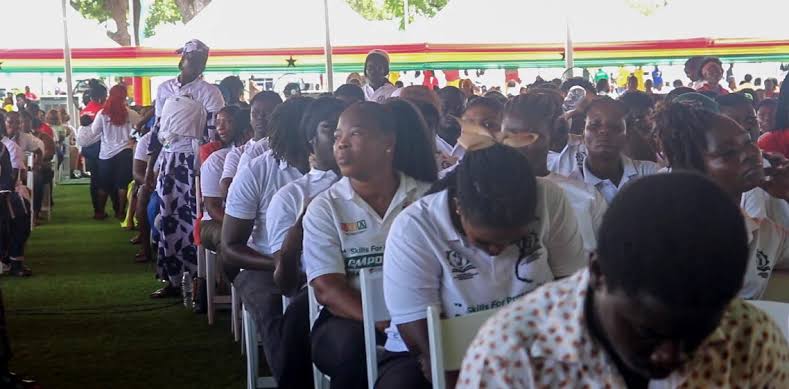
The pilot phase of the National Apprenticeship Programme generated unprecedented enthusiasm among young Ghanaians, receiving more than 300,000 applications from across the country.
Although the government initially aimed to train 10,000 beneficiaries, intense demand led to the enrollment of 14,335 apprentices—representing a 43% increase over the original pilot target. Out of those enrolled, 13,309 successfully completed their rigorous training modules, marking a major milestone in expanding equitable access to vocational mastery.
The initiative was officially launched in Tamale on April 30, 2025, by President John Dramani Mahama under the guidance of the Ministry for Youth Development and Empowerment, led by Minister George Opare Addo, and implemented by the National Youth Authority (NYA), headed by CEO Lawyer Osman Ayarana.
Addressing the graduands, President John Dramani Mahama praised the perseverance of the inaugural class and reaffirmed his administration's commitment to dignity in labor.
"Today belongs to the 13,309 young men and women who make up our first graduating class of the National Apprenticeship Programme. You have spent months learning your trades, practicing your skills, and earning your trainer's confidence. Your families share in this achievement today," President Mahama stated.
He emphasized that a lack of formal university education or financial hardship should never bar any young person from pursuing a respectable income.
To ensure regional equity, training was deliberately decentralized across all 16 regions of Ghana so that young people in rural and underserved communities enjoyed the exact same opportunities as those in Accra or Kumasi.
TheUpper West Region recorded the highest number of beneficiaries, with over 2,200 graduands, followed closely by the Northern Region with over 1,900 participants. The Ashanti and Greater Accra regions each accounted for more than 1,400 graduates, while the Eastern and Upper East regions trained over 1,000 apprentices apiece, alongside thousands more spread across the remaining ten regions.
A defining highlight of the graduating class was the remarkable participation of women, who comprised 10,325 of the 13,309 graduates—representing nearly 78% of the total cohort.
This far surpassed the government's initial 40% female inclusion target. While female apprentices excelled in traditional fields such as fashion design, catering, beauty, and personal care, President Mahama actively challenged young women to break boundaries by entering technical, male-dominated trades including electrical installations, plumbing, welding, carpentry, and renewable energy. Encouraging female graduands, President Mahama remarked,"
Every profession, what a male can do, a female can do even better".Additionally, the pilot cohort successfully trained 112 persons living with disabilities, with targets set to expand disability inclusion in subsequent cohorts.
To eliminate financial barriers, the government assumed full responsibility for training fees paid directly to accredited master craft persons. Apprentices received monthly stipends for transportation, essential learning tools, personal protective equipment (PPE), workplace safety insurance, and formal certification through the Commission for Technical and Vocational Education and Training (CTVET).
Training was structured around nine broad industry areas—spanning fashion and textiles, agriculture and agro-processing, artisanal trades (carpentry, masonry), mechanical and electrical works, catering, renewable energy, hospitality, creative arts, and ICT. Crucially, the curriculum prioritized practical application, allocating 70% of training time to hands-on workshop experience and 30% to theoretical knowledge and entrepreneurship skills.
To ensure graduates transition seamlessly from apprenticeship to economic independence, several strategic post-graduation initiatives have been deployed.
NYA CEO Lawyer Osman Ayarana unveiled the NAP Connect mobile app, a digital marketplace platform allowing graduates to showcase their services, market their craftsmanship, and connect directly with clients across Ghana.
For those looking to launch businesses, President Mahama directed graduates toward the Adwumawura Programme, noting,
"You'll get the start-up capital to establish your business and become an entrepreneur".
Furthermore, Minister George Opare Addo announced practical exit support, including equipped tricycles designed as mobile workshops for tailors and artisans, free co-working spaces with high-speed internet at the NYA headquarters in Accra, and dedicated youth trade hubs within 24-hour markets across the country.
Graduates will also be prioritized for international labor mobility contracts in the Caribbean and Middle East, as well as procurement opportunities within Ghana's 24-hour economy framework.
Looking ahead, the government plans to scale up the National Apprenticeship Programme to train at least 50,000 apprentices in 2027.
This scale-up will be anchored by GH¢1 billion in dedicated funding derived from uncapping the Communication Service Tax.
To guarantee long-term financial sustainability beyond government budgets, Youth Minister George Opare Addo proposed the creation of a National Apprenticeship Levy, under which private sector industries that rely on skilled labor will contribute modestly to fund future generations of apprentices.
The graduation of 13,309 young apprentices marks a transformative dawn for Ghana's industrial workforce and youth self-reliance.
By pairing practical skills with digital connectivity through the NAP Connect app, start-up capital support,and robust institutional backing, Ghana is demonstrating that technical mastery is a primary driver of economic growth. As the programme prepares to expand to 50,000 youth in 2027, the future of Ghanaian industry rests firmly in skilled, confident hands.
Comments (0)
No comments yet. Be the first to share your thoughts.