

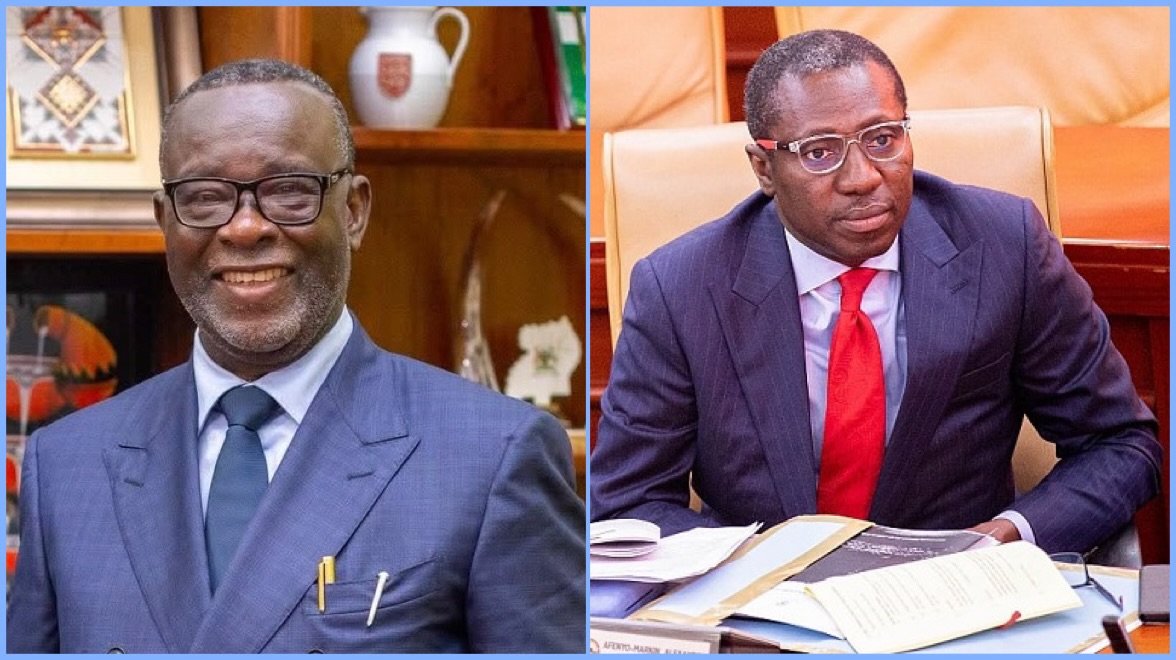
Minority Leader Alexander Afenyo-Markin has accused Chief Justice Paul Baffoe-Bonnie of orchestrating a grand conspiracy. Speaking in a candid interview on Atinka TV, the Effutu Member of Parliament alleged that the current Chief Justice was actively involved in the controversial removal of his predecessor, Gertrude Torkornoo.
This public accusation has reignited a fierce national debate regarding the independence of the judiciary, the political undertones of judicial appointments, and the integrity of constitutional procedures in Ghana.
The controversy traces its roots back to September 2025, when then-Chief Justice Gertrude Torkornoo was removed from her high office. Her removal followed proceedings initiated under Article 146 of the 1992 Constitution, which were triggered by petitions alleging misconduct against her.
A formal committee of inquiry, chaired by Supreme Court Justice Gabriel Scott Pwamang, conducted the investigation that eventually led to her exit. However, according to Afenyo-Markin, the entire process was heavily compromised from within. The Minority Leader openly alleged that Justice Paul Baffoe-Bonnie’s involvement in the plot was driven by personal ambition, specifically his desire to occupy the position of Chief Justice himself.
He went on to assert that other unnamed Supreme Court judges were also complicit in the maneuvers against their colleague, promising that the full truth behind these actions would eventually come to light.
This is not the first time the Effutu lawmaker has vehemently criticized the proceedings. During the parliamentary vetting of Justice Baffoe-Bonnie in November 2025, Afenyo-Markin raised serious questions about how the multiple petitions against Torkornoo were handled, calling the inquiry a travesty of justice.
Despite strong opposition from the Minority, Baffoe-Bonnie’s nomination was eventually approved by Parliament, allowing him to assume the role of Chief Justice. The ongoing fallout has since turned into a highly polarized partisan battle, with the opposition New Patriotic Party (NPP) repeatedly accusing the governing National Democratic Congress (NDC) of undermining judicial independence through the removal of Torkornoo.
In contrast, the NDC administration has firmly defended the process, insisting that the constitutional procedures outlined in Article 146 were followed strictly and transparently.
The Minority Leader has now intensified his political campaign by renewing his calls for the immediate reinstatement of Gertrude Torkornoo to her former position. Arguing that her removal was structurally flawed and politically motivated, Afenyo-Markin remains resolute that her return is necessary to restore the credibility of the judiciary.
This demand adds a fresh layer of tension to an already fraught relationship between the executive and legislative factions. As public interest in the matter intensifies, the allegations place immense pressure on the Supreme Court to address these accusations of internal collusion, leaving many Ghanaians to ponder the future of judicial neutrality and democratic stability in the country.
The explosive allegations leveled by Alexander Afenyo-Markin against Chief Justice Paul Baffoe-Bonnie have laid bare deep-seated anxieties over the politicization of Ghana's judiciary. As calls for Gertrude Torkornoo's reinstatement grow louder and the political divide between the NPP and NDC widens, the demand for transparent, independent public institutions has never been more urgent.


Comments (0)
No comments yet. Be the first to share your thoughts.