

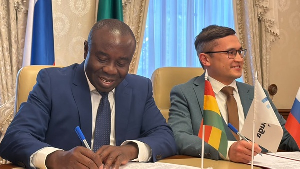
In a major economic and diplomatic development, Ghana has officially signed a landmark agreement with Russia to expand international employment opportunities for its workforce. Through a newly executed Memorandum of Understanding (MoU), Ghanaian job seekers will gain structured access to industrial and manufacturing roles in one of Russia’s primary economic zones. This strategic partnership marks an essential step in bilateral relations while directly supporting national efforts to curb unemployment through transparent labour mobility.
The bilateral agreement was formally concluded between Ghana’s Minister of Labour, Employment and Job Creation, Emmanuel Agyekum, and E.R. Safuillin, Director of Russia’s Alabuga Special Economic Zone. Situated in the Yelabuzhsky District within the Republic of Tatarstan, Alabuga ranks among Russia's largest and most developed industrial hubs. The zone currently hosts more than 48 operating companies across diverse manufacturing sectors and requires over 75,000 workers to fulfill operational demands. The newly established framework aims to create clear pathways to recruit qualified Ghanaian talent directly into these vacant industrial roles.
Highlighting the strategic importance of the deal, Minister Emmanuel Agyekum stated that the initiative forms part of
"President John Dramani Mahama's broader vision for job creation, skills development, and expanding decent employment opportunities for Ghanaians both at home and abroad".
He underscored that the deal directly supports government efforts to address unemployment through regulated foreign employment. Rather than leaving workers to navigate foreign job markets independently, the bilateral arrangement emphasizes orderly and transparent recruitment that prioritizes worker welfare and rights.
To safeguard citizens and ensure a smooth recruitment process, Ghana’s Ministry of Labour, Employment and Job Creation will take an active coordinating role. Under the terms of the MoU, the Ministry is tasked with verifying job offers, conducting precise skills matching between applicants and Russian employers, and delivering comprehensive pre-departure orientations.
These protective measures aim to guarantee that workers are fully informed of their contractual rights before traveling. Technical teams on both sides are now finalizing operational guidelines to convert the agreement into active job placements, signifying a new chapter in Ghana-Russia economic cooperation focused on human capital.
This new labour recruitment deal offers exciting prospects for Ghanaian artisans, technicians, and industrial workers seeking international career experience under state-regulated protections. By pairing high job demand in Tatarstan with government-led oversight, the agreement establishes a structured pathway for youth employment and global skills development.

Comments (0)
No comments yet. Be the first to share your thoughts.