

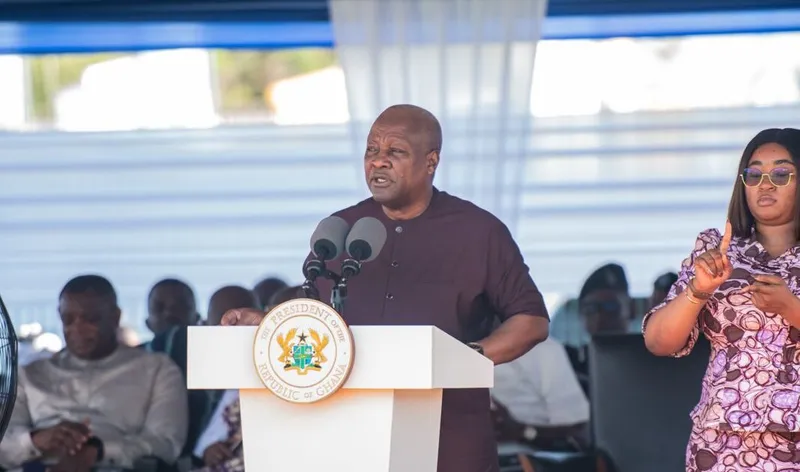
Youth employment and sustainable economic growth remain top priorities for Ghanaians looking toward a brighter financial future. During the 2026 Hogbetsotso Festival grand durbar in Anloga, President John Dramani Mahama unveiled a major intervention: a commitment to channel over US$9 billion into high-impact, job-creating sectors between 2027 and 2030 under his administration's proposed “New Economy” policy.
Designed to secure decent and dignified livelihoods for citizens, the blueprint prepares the ground for Ghana's next economic chapter ahead of the official 2027 Budget Statement presentation.
President John Dramani Mahama officially announced the four-year capital injection on Saturday, November 7, explaining that the comprehensive framework will be laid before Parliament when Finance Minister Dr. Cassiel Ato Forson delivers the 2027 Budget Statement and Economic Policy on Thursday, November 12. Addressing the gathering at the festival grounds, President Mahama emphasized the bold scope of the programme:
“In this presentation, we will outline our plan for what we call the New Economy. This is a bold initiative that will seek to invest over $9 billion in job-rich sectors of the economy between 2027 and 2030”.
This targeted window refines the broader five-year, US 2billion annually across nine productive pillars including pharmaceuticals, agribusiness, textiles, and tourism without resorting to new borrowing. Under the four-year, US$9 billion rollout, specific regions are already designated for strategic support.
For instance, President Mahama highlighted that the Volta Region is positioned to gain substantially from dedicated investments in high-capacity sectors, noting:
“The Volta Region is expected to benefit greatly under the New Economy policy, particularly in the areas of textiles, garments, commercial agriculture, hospitality and tourism”.
Complementing these macro-level sector allocations, local infrastructure delivery remains linked to grassroots decentralization reforms. Ongoing district works spanning healthcare facilities, classroom blocks, and feeder roads continue to draw funding through the District Assemblies Common Fund (DACF), reinforced by an executive directive ensuring that at least 80 percent of DACF disbursements are transferred directly to local assemblies.
In response to the upcoming policy rollout, civic and economic monitors such as the Institute for Economic Research and Public Policy (IERPP) have urged the government to clearly detail the programme’s financing model, investment benchmarks, and exact sector breakdowns within the budget statement.
From a fiscal and monetary perspective, the initiative plays a central role in national debt recovery and capital market rehabilitation. Following the severe fallout of the 2022 domestic debt default and Domestic Debt Exchange Programme—which paralyzed the local bond market and cut banks off from credit lines—Ghana has regained stability and attained a B credit rating.
Finance Minister Dr. Cassiel Ato Forson explained that the New Economy strategy is tailored to drive Ghana toward an investment-grade sovereign rating to dramatically reduce national borrowing costs and unlock long-term domestic financing for enterprises. Outlining this goal during policy engagements in Accra, Dr. Ato Forson stated:
“Now we have restored it and the country is now rated B. We want to get to investment grade. If we are able to get to investment grade, we would have laid the foundation for corporate bonds and others to take off”.
He further underscored that achieving this milestone demands policy predictability and macroeconomic stability, ensuring that national financial growth translates directly into household financial security across Ghanaian homes.
The upcoming presentation of the 2027 Budget Statement on November 12 stands as a defining milestone for Ghana’s fiscal direction and employment landscape. With US$9 billion targeted at productive, non-debt-driven job creation and an overarching push toward an investment-grade credit rating, the New Economy framework seeks to deliver both macroeconomic resilience and tangible livelihoods for everyday citizens.
Comments (0)
No comments yet. Be the first to share your thoughts.