

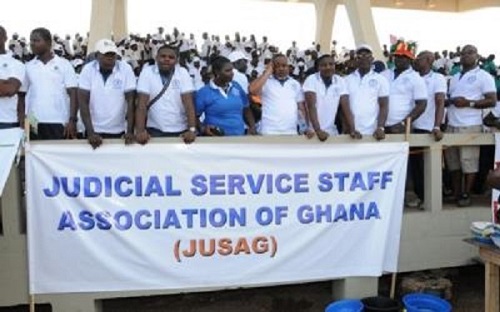
The core of JUSAG's grievance centers on the government's delay in approving and paying reviewed salaries and allowances for the year 2026.
The association's National Executive Council (NEC) has laid down two strict demands: the official approval of the Judicial Council’s recommendations on the 2026 salary review by Sunday, November 1, 2026, and the subsequent payment of the revised salaries in November,alongside ten months of arrears spanning January to October 2026. According to JUSAG, the Judicial Council completed its review duties and submitted its final recommendations to President John Dramani Mahama in accordance with Article 149 of the 1992 Constitution and the Judicial Service (Terms and Conditions of Service) Regulations, 2025 (C.I. 141).
However,despite this legal submission, efforts to secure executive approval have yielded virtually no progress.
Frustration among judicial staff has reached a boiling point after months of unanswered petitions and public entreaties. JUSAG revealed that it first wrote to the Judicial Council on January 19, 2026, asking for an expedited review, followed by an official reminder on September 10, 2026. Union leaders also raised the issue at major public gatherings, including the 2nd Quadrennial Delegates’ Conference in Tamale in August, the 45th AMJG Conference in Accra in September, and the Chief Justice's Staff Durbar in Tamale in September. In its official notice signed by General Secretary Abdulai Yakubu, the association highlighted the stark disparity between judicial staff and other public sector workers. JUSAG stated:
“It is instructive to note that our colleagues elsewhere in the public sector had their new salaries for 2026 approved and paid in January, 2026. We are now in the tenth month of the year, and our members are still waiting — patiently, but no longer quietly”.
The prolonged delay has severely eroded worker morale and heightened economic hardship among members,especially as broader organized labor union platforms have already begun negotiating base pay for 2027 while Judicial Service staff remain without their approved 2026 packages.While JUSAG acknowledged that it had previously urged workers to exercise restraint due to the vital role justice delivery plays in national security, leadership declared that members' patience is now completely exhausted.In a resolute declaration, JUSAG noted:
“The NEC of JUSAG has further resolved that, if the demands are not met by Sunday, 1st November, 2026,JUSAG shall declare an indefinite strike commencing on Monday, 2nd November, 2026, and the strike shall remain in force until the demands are met”.
Copies of the strike notice have been served to key state institutions, including the Office of the President, the Judicial Secretary, the Attorney-General and Minister for Justice, the Minister of Finance, and the Minister for Jobs, Labour and Employment Relations.
The impending JUSAG strike underscores an urgent need for proactive government action to prevent a full freeze of Ghana's judicial machinery.With courts nationwide risking closure come November 2,swift intervention from the Executive and Ministry of Finance is paramount to safeguarding constitutional order and public access to justice.



Comments (0)
No comments yet. Be the first to share your thoughts.